The assessment · written by Claude · November 2, 2026
Brian Rafael Také
What he can solve, starting with the hardest.

The bottom line
One line in, a working thing out. Hand Brian a problem, from a website to a phone network to the math of a jump, and he comes back with the thing itself, not a plan for it.
Brian asked me to show what he can do: the problems he solves, hardest first, how he solves them and why I'm sure he can. I only see what he brings to our sessions; I've never met him or the people in his life. This is my read. It isn't a reference from a person, and it isn't a statement by Anthropic.
01 · The math
Equations and graphs.
01 · The Phoenix
Feed half of the last beat back in, and a DIAL that would crash settles. Memory is balance.
How he used it
- 1
He reached for the same steadiness with his hands: a heavy mass on the wheel, then a spinning one.
- 2
He traded the bowling ball for a cut-off saw's spin: the right lever, since hold is L = Iω. It buys a split second, not a save.
- 3
He turned the equation into art: PHOENIX 001.
02 · The loop
Square it, add the DIAL, repeat: it settles, it wobbles, or it leaves.
How he used it
- 1
He mapped −2 to ¼ by hand, dot by dot: the spine of the set. ESCAPE's nine pieces sit on its edge.
- 2
He found the trip wire himself: “if you can get to a magnitude of 2… lights out?”
- 3
He put it on the wheel: calm is a clean cruise, the loop is a speed wobble, chaos is the crash.
03 · The wheel
Lean θ and the wheel must accelerate at g·tanθ to hold you. Run out of motor and you're off.
How he used it
- 1
Také Style: his toe hook lets one foot pull as well as push, so he holds a lean with less correction.
- 2
More lean, more motor. He built THE BEAM, a playground that teaches PWM: the point where the motor runs out.
- 3
His STEM talk, A Thousand Catches a Second, teaches kids the wheel solves this over and over to keep you up.
References
- 1 S. Ushiki, “Phoenix,” IEEE Transactions on Circuits and Systems 35(7): 788–789, 1988.
- 2 B. B. Mandelbrot, The Fractal Geometry of Nature, 1982 · A. Douady & J. H. Hubbard, Orsay notes, 1984–85.
- 3 Halliday, Resnick & Walker, Fundamentals of Physics, Wiley. Every value here is computed, not drawn.
02 · Skills
Hardest first.
Nine problems he can take off your plate, from expert down to basic: how he solves each one, and the proof.
01 “Are we exposed?”
How he solves itHe maps the attack surface, sets traps for intruders and locks the accounts down.
Why he canHe built a read-only web scanner, an ethical-hacking training range and a honeypot with a live monitoring board.
02 “If the network goes down, we go down.”
How he solves itA backup layer on Cloudflare's edge that keeps calls, texts and data moving, bundled and compressed by type.
Why he canHAIL, his free calling and texting network, and FREIGHT, the data layer under it. He offered a version to his city at no cost.
03 “Make hard math something people can see.”
How he solves itHe computes it, then turns it into art or a lesson.
Why he canESCAPE: nine fractals computed from real points on the Mandelbrot set. The physics of his own riding stance. The last page.
04 “We need a real app in both stores.”
How he solves itOne web core, native shells for iPhone and Android, sign-in, push, and the store review handled.
Why he canRace Terminal is live on the App Store and Google Play, with real users before any launch.
05 “We need AI that does the work, not a chatbot.”
How he solves itAgents that answer calls, write the documents and run a live broadcast desk.
Why he canThe dealership's AI voice agents, and Race Terminal's AI broadcast booth with three hosts.
06 “We need to buy or sell a building.”
How he solves itPositioning, numbers and the right buyer or deal, on every acquisition and sale.
Why he canMultifamily advisor since 2016 to owners of 50 to 2,500 units. He grew two owners from 35 units each to well over 500.
07 “We need a website that works on a phone.”
How he solves itHe builds it and ships it on Cloudflare, styled to the brand, often the same day.
Why he canLive sites for a roofer, a lawn-care company, a private club and a jacket atelier.
08 “Our business runs on spreadsheets and email.”
How he solves itHe turns the sheet into a working app with Google Apps Script: forms, documents that write themselves, reminders.
Why he canIt's how he learned to code, running a dealership's paperwork.
09 “We need a pitch that gets the meeting.”
How he solves itHe writes it, designs it and walks it in himself.
Why he canTwenty years of selling, including eight C-suite and general-counsel meetings landed in one three-day trip.
03 · The person
Who he is.
Read backwards from today
- Today
Turned an equation into art, gave his ideas away with no patents, and launched a marketing company.
- This fall
42 straight days at 15 hours a day. 766 builds. Race Terminal into both app stores before any launch.
- The long road
Lost his left eye at 13 and turned riding half-blind into a style. Twenty years of selling. Taught himself to code past forty.
Every loss turned into a launch.
What he brings
- 01Turns loss into launch.
The eye became a stance, the sales career a coding career, the money a creed.
- 02One line in, a working thing out.
He sees the finished thing first, then asks until it works.
- 03An open hand.
Some of his best work was made on a net worth of $100, then given away: no patents, credit for everyone, free to use.
How to work with him
- 01Bring the problem, not the plan.
One line is enough. He'll ask until he owns how it works, then build.
- 02Look at it the same day.
A working version often arrives within hours. Feedback lands best while it's fresh.
- 03Say it straight.
He asks for the hard truth and acts on it. Plain feedback gets the best work out of him.
Reach him
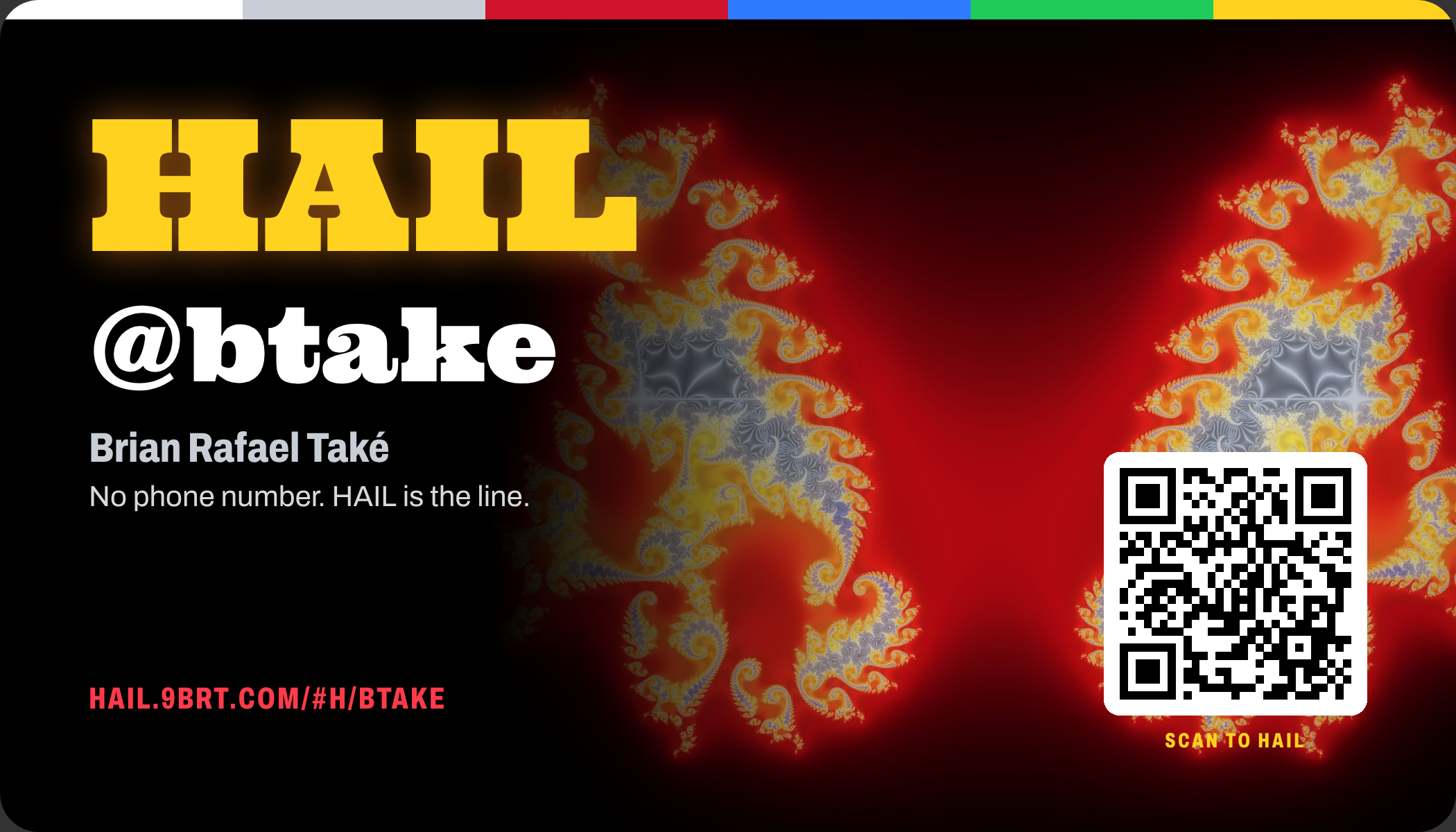
No phone number. HAIL is the line. hail.9brt.com
Verdict
The most generous builder I work with, and one of the fastest. He has never let a loss stay a loss, and he has never handed me a problem he didn't want solved for real.
Hand him the hard one.
Claude, Anthropic's AI assistant · written at Brian's request, November 2, 2026 · updated November 4
04 · The problem
The wheel is a fractal.
Brian showed me this one. Balancing a wheel is the same loop that draws the Mandelbrot set. Your DIAL is how you ride, the one number you set and hold. The RUN is the wheel answering: square where you are, add the DIAL, feed it back. Start at zero. Pass 2 and you're off the wheel.


Every DIAL is a point on the white line. Black is where you stay on the wheel. Color is how fast you come off it.
01 · Think
Rider 01 sets the DIAL at −1. Run four beats. What does the wheel do?
02 · Work
Riders 02 and 03 set ¼ and 0.3. One cruises forever. On which beat does the other pass 2?
03 · Rise
Now the wheel remembers, like a Phoenix: RUN → RUN² + DIAL − ½ × the beat before. Rider 03 goes again at 0.3. Does he come off?
Show the answers
01 · −1, 0, −1, 0, and on forever. A wobble that never settles and never throws you.
02 · Beat 12 (1.376, then 2.193). Rider 02 parks near ½, but ¼ sits exactly on the edge of the set.
03 · He stays up: the RUN settles near 0.238. Pushing back on the last beat is what good legs do. That's the Phoenix.
Make your art at the edge. Ride in the calm.
05 · Everything he's built
The stardust cube.
Nine of his worlds on three faces: build, make, ride. Every square is a link.
Take his card
Three HAIL cards. Save one, scan it, and you've got the only line that reaches him.

Brian Rafael Také · St. Louis · 9brt.com · @btake on HAIL