The bio
One wheel, no handlebars
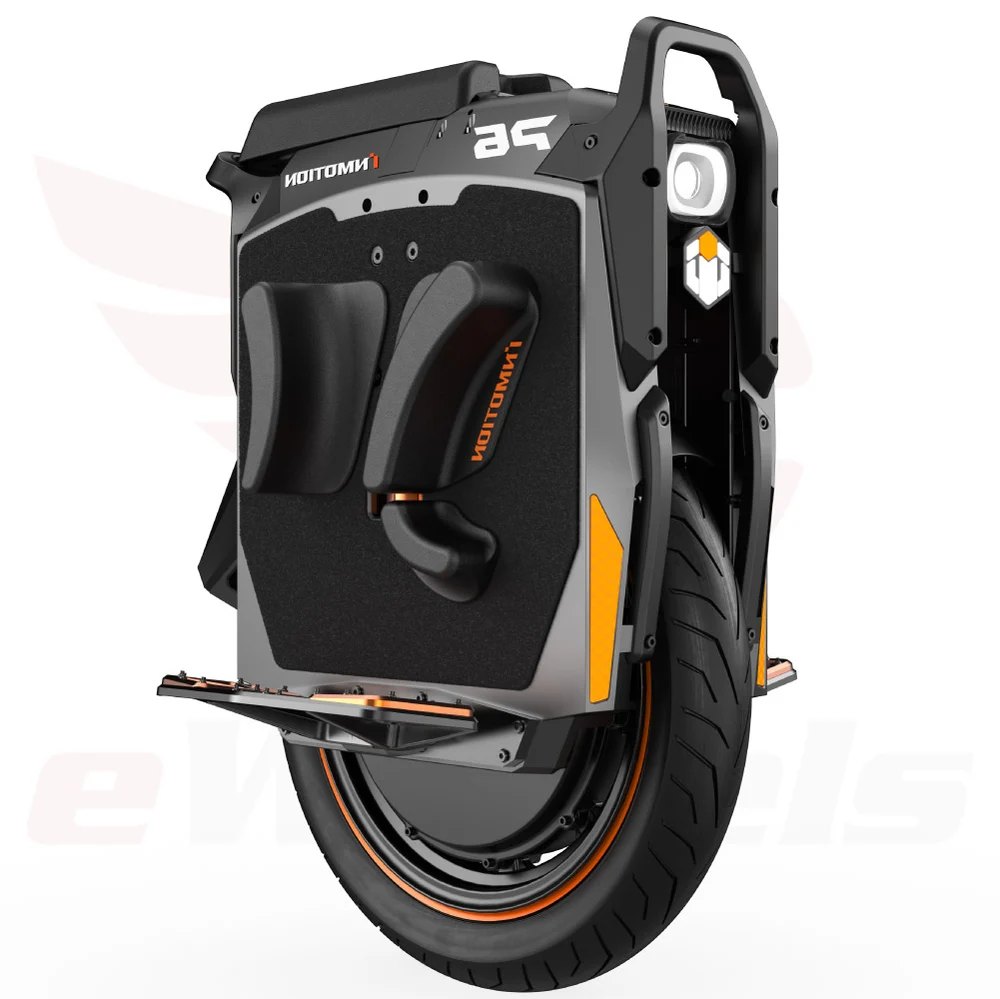
INMOTION unveiled the P6 on October 11, 2025, built on a 235-volt system, which is high for a wheel. Higher voltage moves the same power with less current, and less current means less of it wasted as heat in the wires and the motor. A 4,200 Wh battery of Samsung 50S cells feeds a motor rated 6,000 W for steady riding that can peak at 20,000 W, about 27 horsepower, all through one 80/90-14 motorcycle tire.
It has no handlebars, no seat and no second wheel. It stays up the way you balance a broom on your hand. Sensors feel which way the wheel is tipping, and the controller drives the tire back under the rider's center of mass, again and again, faster than he can feel it. Lean forward and it rolls forward to catch you. Lean back and it brakes. That loop is what Brian's school talk, A Thousand Catches a Second, is about.
Under the shell: a silicon-carbide controller cooled by a copper vapor chamber and a fan, 90 mm of hydraulic suspension in the middle of the wheel, and pedals the rider tunes from the app. It weighs 112 lb and will carry 309 lb more.
Why it matters for the season: the ramp-kit math needs a real wheel. Holding 40 mph up the 20° launch face takes about 9.6 kW for 275 lb of rider and wheel. The P6 peaks at 20 kW, so the finale climb uses about half, and the other half stays free to keep catching Brian's balance.
How it pushes
The wheel is a lever
The motor sits inside the hub and twists the tire. That twist is torque, written τ. The tire shoves the road backward, and the road shoves the wheel forward just as hard: Newton's third law. For the same twist, a bigger tire means a gentler push:
F = τ ÷ r
The P6 makes 300 N·m on a tire about 0.50 m tall, so a radius of 0.25 m. That's a push of about 1,200 newtons on the road, roughly the weight of a 270-pound person, pointed forward.
The spec sheet
The numbers INMOTION prints
| Voltage | 235 V high-voltage platform |
|---|---|
| Battery | 4,200 Wh, Samsung 50S cells |
| Motor | 6,000 W rated, 20,000 W peak |
| Torque | 300 N·m |
| Top speed | 93 mph (150 km/h) |
| 0 to 30 mph | 1.9 seconds |
| Range | Up to 93 miles (150 km) |
| Weight | 112 lb, carries up to 309 lb |
| Tire | 80/90-14 |
| Suspension | Center-mounted hydraulic, 90 mm of travel, high- and low-speed damping |
| Climb | Up to 45° |
| Charging | 4 hours on the standard 1,176 W charger; 80% in 1 hour on the optional 14 A charger |
| Weather | IPX6 body, IPX7 battery |
| Size | 29 × 20 × 11 in |
| Brains | Silicon-carbide controller, copper vapor-chamber cooling with a fan |
Source: INMOTION, P6 product page, and INMOTION's launch announcement, October 11, 2025.
Solve it. Don't try it.
Check the spec sheet
Companies print numbers. Scientists check them. Seven problems on the real P6, from ★ Rookie (grades 6 to 8) to ★★★ Engineer (physics class). Work it out first, then open the answer.
- ★ Rookie
The battery holds 4,200 Wh and the standard charger pushes 1,176 W. How long does an empty-to-full charge take, at best? INMOTION says 4 hours. Why might the real number be longer?
Show the answer
About 3.6 hours. Charging slows down near full to protect the cells, and some energy turns into heat, so 4 hours is honest.
- Time = energy ÷ power = 4,200 Wh ÷ 1,176 W = 3.57 h.
- ★ Rookie
INMOTION says the P6 uses about 25 Wh per kilometer. How far should 4,200 Wh go? They promise up to 150 km. Who's right?
Show the answer
168 km on paper. The promise is lower because no rider gets every last watt-hour: as the battery runs low, the wheel slows you down and saves the rest so it can keep balancing you.
- Distance = 4,200 Wh ÷ 25 Wh/km = 168 km.
- ★★ Pro
One watt-hour is 3,600 joules. How many joules are in the battery? At 235 volts, how many amps does the motor pull at its 20,000 W peak?
Show the answer
15.1 million joules. About 85 amps at peak.
- 4,200 × 3,600 = 15,120,000 J.
- Current = power ÷ voltage = 20,000 ÷ 235 = 85.1 A.
- ★★ Pro
Read the tire size 80/90-14: a 14-inch rim, a tire 80 mm wide, with sidewalls 90% as tall as the tire is wide. How tall is the whole tire? How many times a second does it spin at 30 mph?
Show the answer
About 0.500 m (19.7 in) tall. About 8.5 turns a second (513 rpm).
- Rim = 14 × 25.4 = 355.6 mm. Sidewall = 0.90 × 80 = 72 mm, and there's one above and one below.
- Height = 355.6 + 2 × 72 = 499.6 mm.
- Around = π × 0.4996 = 1.570 m.
- 30 mph = 13.41 m/s; 13.41 ÷ 1.570 = 8.54 turns per second.
- ★★★ Engineer
The motor twists the wheel with 300 N·m. Force at the ground = torque ÷ tire radius. For 275 lb (125 kg) of rider and wheel, what's the most it could accelerate? INMOTION claims 0 to 30 mph in 1.9 s: is that inside the limit? To accelerate, a rider has to lean forward until tan(lean) = acceleration ÷ g. How far does he lean for the claim?
Show the answer
About 1,201 N, so up to 9.6 m/s² (0.98 g). The claim averages 7.06 m/s², inside the limit. He leans about 36°.
- Radius = 0.4996 ÷ 2 = 0.2498 m. Force = 300 ÷ 0.2498 = 1,201 N.
- a = F ÷ m = 1,201 ÷ 125 = 9.61 m/s².
- Claim: 30 mph = 13.41 m/s in 1.9 s → 7.06 m/s².
- Lean = tan⁻¹(7.06 ÷ 9.8) = 35.8°.
- ★★★ Engineer
Finale check. Holding 40 mph up the 20° launch face takes m × g × v × sin 20° plus ½ × 1.2 × 0.6 × v³ for the air. With 125 kg, how much power is that, and what share of the P6's 20 kW peak?
Show the answer
About 9.55 kW, 48% of peak. Half the peak stays free for balance, so the 20° kit works, with little to spare.
- 40 mph = 17.88 m/s. Climb = 125 × 9.8 × 17.88 × 0.342 = 7,492 W.
- Air = ½ × 1.2 × 0.6 × 17.88³ = 2,058 W.
- Total = 9,550 W, 47.8% of 20,000 W.
- ★★★ Engineer
INMOTION lists 93 mph. Physics check: if all 20 kW went into beating the air with the rider tucked (drag area 0.45 m²), what top speed comes out? Why will Brian never ride it there?
Show the answer
About 42.0 m/s, 94 mph, right on INMOTION's number. With every watt spent on speed, nothing is left to catch a lean, and a wheel that can't catch you throws you.
- Power = ½ × 1.2 × 0.45 × v³, so v = (20,000 ÷ 0.27)^(1/3) = 42.00 m/s = 93.9 mph.