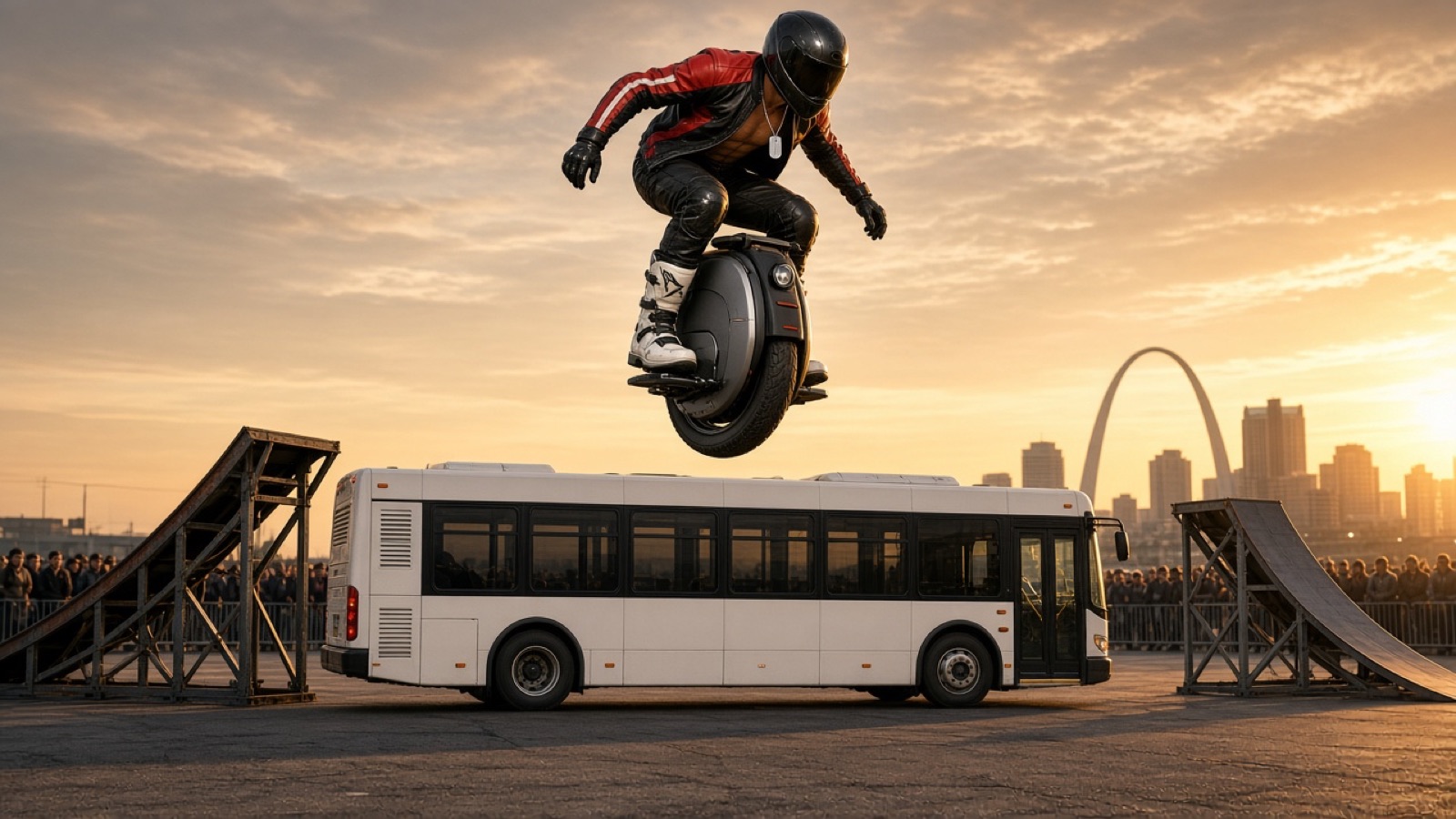
01 The stunt
The jump
A 40-foot city bus parked nose-on in a lot, nobody on board. A ramp behind it, a landing in front of it, and the wheel goes over the whole roof, bumper to bumper: 53 feet at 35 mph. It comes with a question about the bus itself.
The work
Measuring the bus. Reaching 35 mph at the lip, every time, on a runway long enough to get there and to stop. Landing the 53-foot gap over a bus-length frame at ground level before a real bus is ever parked between the ramps.
The night
A parking lot, a crowd behind barriers, the bus in the middle. After the landing, the big screen shows what that bus costs per rider: nearly empty, half full and packed.

Concept. Not performed yet.
What gets measured
- Speed at the lip
- Clearance over the roof
- Landing force in g
What has to be true first
- The transit agency says yes and parks an empty bus for it
- The ramps are engineered and load-tested, and the crowd stands well back from the landing
- Landed over a bus-length frame at ground level first
If any one of these is a no, it doesn't happen.
02 The cause · Transit, and the wheel
Stop running 40-foot buses nearly empty. And give the wheel the same rights as a bike.
“Why should a bus have more rights than a wheel? Seriously. The bus is empty. The wheel has a person on it.”
The ask. Size the vehicle to the riders: small and on demand when a route is quiet, big buses at rush hour. Then write the wheel into the law. Missouri has no definition for a one-wheel vehicle, so the official answer is "get off the road." Define it, and give it what a bicycle already has: a lane, a right of way, a place.
My endParalysis. 35 mph, 53 feet, bumper to bumper, no net.
Your endYour name on the petition. Say it out loud: a wheel belongs on the road.
03 The math
When is a bus the cheapest way to move people, and when would a Lamborghini be cheaper?
Ramp kit: 20° launch and landing ramps on 10-foot towers, about a 53-foot gap at 35 mph, over a 40-foot bus end to end.
The formulaCost per rider per mile = cost to run the vehicle one mile ÷ riders on board
Drawn to scale from the workbook's own numbers. The red tags are the questions in Chapter 02: solve them below.
The Lambo analysis
One city bus, or two chauffeured Lamborghinis?
In 2024 Metro St. Louis spent $13.44 to run a bus one mile, with 6.4 people on board on average. A Lamborghini Urus with a paid driver, the car's price included, works out to about $4.81 a mile. Two of them seat eight. On the average, the Lambos win by 28%. Then comes the fine print.
- $13.44to run a Metro bus one mile, 2024
- 6.4riders on board, on average
- $4.81a chauffeured Urus, per mile, car and driver
- $9.62two of them: room for 8
In this corner
The city bus
Metro St. Louis, 2024
- Length40 ft
- Carriesabout 60 with standing
- Price$500,000 diesel
- To run, per mile$13.44
- On board, average6.4 riders
- Per rider-mile$2.10
And in this corner
Lamborghini Urus
Chauffeured, car and driver
- Lengthabout 17 ft
- Carries4 and a driver
- Price$280,736
- To run, per mile$4.81
- On board, full4 riders
- Per rider-mile$1.20
One bus $13.44 to run
Driver, fuel, repairs, the garage and the office, as one number. The dashed end is the bus itself: $1.00 a mile more, and it isn't in the $13.44.
One Urus $4.81, car and driver
Two Urus $9.62: room for Metro's average 6.4 riders
- $2.86 Driver40 ÷ 14 mph
- $1.03 The car(281,000 − 50,000) ÷ 225,000 mi
- $0.50 Repairs and tires50¢ a mile
- $0.27 Insurance12,000 ÷ 45,000 mi
- $0.16 Gas3.20 ÷ 20 mpg
59% of the Lamborghini's mile is the driver. Remember that.
Fig. 03 · Run the numbers
What each rider's mile costs
Slide the riders. Red shading is where the Lamborghinis win. The sawtooth is the Urus fleet: every fifth rider needs another car and another driver.
- One bus, a mile
- Urus fleet
- Bus, per rider-mile
- Urus, per rider-mile
Change the Urus math
The Urus runs on premium: St. Louis averaged $4.69 on October 8, 2026 (AAA). Metro's buses averaged 13.9 mph in service.
The fine print
Seven reasons the hot take falls apart
- 01
The average hides the rush.
6.4 is an average over every mile a bus drove in 2024, the near-empty late-night runs included. At rush hour, 60 people at one stop need 15 Urus and 15 drivers: about $72 a mile against $13.44 for one bus. At its busiest hour Metro had 261 buses on the road at once, and the fleet has to be big enough for that hour, every day.
- 02
Riders don't come in fours.
Nine people need three Urus, and the third one carries a single rider: $14.43 a mile, more than the bus. Past 8 riders the bus is cheaper every time, and the gap only grows.
- 03
The bus's price isn't in the $13.44.
The transit database counts the cost to run a bus, not to buy one. A bus bought with federal money has to run at least 12 years or 500,000 miles. Spread a $500,000 diesel bus over 500,000 miles and it adds $1.00 a mile. An electric bus at $1.1 million adds $2.20. That makes the bus look worse, not better. A fair comparison sometimes hurts the side you're on.
- 04
Empty miles.
The $13.44 is per mile in service, and the bus's trips to and from the garage are already paid for inside it. A chauffeur who drives back empty isn't free. If one mile in three is empty, the Urus's $4.81 becomes $7.22 for every mile with riders on board.
- 05
The driver is the cost.
$2.86 of the Urus's $4.81 pays the driver. One Urus driver moves 4 people. One bus driver can move 60. Whatever a driver costs an hour, the bus spreads it over 15 times more people. That, more than the badge on the hood, is the whole contest.
- 06
Small vehicles cost about $5 a mile, whatever the badge.
A price check on the Urus math: Metro's own Call-A-Ride vans, the door-to-door service for riders with disabilities that the law requires, cost $5.68 a mile to run in 2024, with about 1 rider on board on average. Different job, lifts and help at the door, but the same lesson: a small vehicle with a paid driver lands around $5 a mile. The $4.81 isn't crazy.
- 07
Street space.
Sixty people: one bus, 40 feet long. Or 15 Urus, about 255 feet of Lamborghini nose to tail, before anyone leaves a gap. A city runs out of lanes and curbs before it runs out of money.
The verdict
Both hot takes are wrong.
"Buses are a waste" only looks at the average. "Buses always win" only looks at rush hour. The real answer is in the shape of the day: big vehicles when the crowd is there, smaller ones or fewer runs when it isn't, and service good enough that more people ride. Get Metro's average from 6.4 riders to 12 and every rider-mile drops from $2.10 to $1.12. That's cheaper than a full Lamborghini.
Riders paid about $0.96 a boarding in 2024. Each boarding cost $12.64 to run. Fares covered about 8 cents of every dollar, and taxes covered the rest. So this isn't trivia. It's your money either way.
- $12.64to run one boarding, 2024
- 96¢what the rider paid for it, on average
Sources: National Transit Database, 2024 agency profile: Metro St. Louis · Kelley Blue Book: 2026 Lamborghini Urus · AAA: Missouri and St. Louis gas prices · Brookings: Paying less for public transit buses · Oregon DOT: vehicle useful life minimums (FTA). The Urus numbers are the workbook's own assumptions, laid out in problem 4; change them in the calculator.
Solve the Jump · Workbook, Chapter 02
Grades 6 to 12 (the jump math is 9 to 12)
When is a bus the cheapest way to move people, and when would a Lamborghini be cheaper?
Two problems. The jump: the bus is parked nose-on, so the wheel flies its whole length, and the arc has to stay above the roof from the back bumper to the front one. The bus: it costs about the same to run a bus with 2 people on board or 60, so the cost of each ride is the cost of running the bus divided by the riders. How full the bus is changes everything.
Every jump this season uses the same ramp kit. New to it? Start with The Ramp Kit chapter.
Cost per rider per mile = cost to run the vehicle one mile ÷ riders on board
- Cost per rider-mileWhat it costs to carry one person one mile: vehicle cost per mile ÷ riders on board.
- LoadHow many people are on board on average.
- Peak demandThe busiest time, like rush hour, that the system has to be sized for.
- Capital costThe price of buying the vehicle, spread over the miles it will run.
Worked example
In 2024 it cost Metro St. Louis $13.44 to run a bus one mile, with 6.4 riders on board on average. What does each rider's mile cost?
- Riders on board = passenger miles ÷ bus miles = 76,719,531 ÷ 11,973,112 = 6.41.
- Cost per rider-mile = $13.44 ÷ 6.41 = $2.10.
- Fares paid for about 8 cents of every dollar it cost to run the buses.
Your turn: three problems, one for each level
- ★★ Pro
The jump. The bus is 12.2 m (40 ft) long and 3.2 m (10.5 ft) tall, parked nose-on in the middle of the gap. The season's 20° ramp kit sits on 3.0 m (10 ft) towers, and the plan is 35 mph at the lip. How wide is the gap between the lips, how high does the arc rise above the lip, and how long is the wheel in the air?
Show the answer
The gap is about 16.1 m (53 ft), longer than the bus. The arc rises 1.46 m (4.8 ft) above the lip, so the top of the arc is 1.26 m over the roof, and the wheel is in the air 1.09 s.
- 35 mph = 15.65 m/s.
- Gap = 15.65² × sin(40°) ÷ 9.8 = 16.06 m.
- Height = (15.65 × sin 20°)² ÷ 19.6 = 1.46 m; 3.0 + 1.46 − 3.2 = 1.26 m over the roof.
- Air time = 2 × 5.35 ÷ 9.8 = 1.09 s.
- ★★★ Engineer
With identical ramps at the same height, the top of the arc is exactly halfway across, and the ends of the roof are 6.1 m either side of the middle. The wheel is lowest over the roof at its two ends. How much room is there over the back bumper, and over the front one?
Show the answer
The same at both ends, about 42 cm (16 in). That's the real margin, not the 1.26 m at the top of the arc.
- Halfway = 8.03 m. The back of the roof is 6.1 m before the middle: x = 8.03 − 6.1 = 1.93 m from the lip.
- Height there = x × tan 20° − 9.8 × x² ÷ (2 × 15.65² × cos² 20°) = 0.62 m above the lip.
- Clearance = 3.0 + 0.62 − 3.2 = 0.42 m.
- The arc is symmetric, so the front end gets the same answer.
- ★ Rookie
The bus. Using $13.44 a mile, how many riders does a bus need for each rider's mile to cost under 50 cents? Under $1?
Show the answer
27 riders for under 50 cents, 14 riders for under $1.
- 13.44 ÷ 0.50 = 26.88, so 27 riders.
- 13.44 ÷ 1.00 = 13.44, so 14 riders.
The engineer's question
“Landed over a bus-length frame at ground level first.”
This has to be true before the attempt. Why?
What to look for
A frame the length of the bus proves the speed, the lip position and the landing where a miss costs nothing. The real bus only goes between the ramps once the numbers repeat.
Solve it. Don't try it. The predictions get settled by the real numbers on the night.
The landing
Now it's your turn.
- 01Solve the jumpCall the landing before I make it. Free, grades 6 to 12.→
- 02Put a hero on the wallYou or someone else. Earn your belts, White to Black.→
- 03Sign your nameAll I'm asking for. It tells the city St. Louis wants this.→
This time, everyone sees it coming.For glory, not money · Solve it first